We Watched Cats Get The
Blame For Something That
Wasn't Their Fault.
The real reason KittyLoop exists — and why five very different cat owners are all missing the exact same thing without knowing it.
This isn't about the couch.
The couch is just the thing you can see. What actually keeps you up at night is the feeling behind it — the feeling that you're failing a creature who trusts you completely.
Maybe it shows up as damage. You come home to the armrest again, the corner of the sofa, the fourth scratching post completely untouched three feet away. "Cat 10, me 0." "Money down the drain." "The reason I can't have nice things." You're not angry at your cat. You're exhausted. You're out of ideas. And somewhere underneath the frustration is something quieter: I should have been able to fix this by now.
Maybe it shows up as guilt. Every morning, the same ritual — keys, bag, coat, door. The way they sit there and look at you when you leave. You think about them all day in a quiet apartment, staring at walls, sleeping in the exact spot they were in when you left. "I feel beyond myself with guilt." "I am a wreck the entire commute." "I feel like I'm failing her." Those aren't thoughts you say out loud. But they're there, every single day.
Maybe it shows up as fear. You flinch at the corner of the hallway now. You know the ambush can come at any time — from the cat purring next to you one second, teeth in your wrist the next. "My nervous system is spiked 24/7. I dread coming home to my own safe space." You love them completely and you're also afraid of them. And the shame of that — that's the part nobody in the cat forums says out loud either.
Maybe it's the number on the vet's scale. The phrase "at risk." The drive home in silence. "This was my fault." They didn't say it that way. They were professional, kind. But you knew. You've known for months.
Or maybe it's something quieter and slower. A video the algorithm served you at 11pm — an old cat, lost in a room they've lived in for fifteen years, calling out for someone standing right in front of them. And the thought that followed you into sleep: what if that happens to mine? Your cat is eight, or eleven, or fourteen. And you don't know what to do. Or if there's still time to do it.
Five very different people. Five very different sleepless nights. None of them failing. All of them missing the same thing — and nobody ever told them what it was.
We were that person too. And when we finally found out what was actually happening — not just to our cat, but to every cat in every one of those situations — it changed how we looked at the entire category.

Every solution we tried
solved the wrong problem.
The scratching posts. Sisal first, then carpet, then corrugated cardboard, then the wall-mounted version that required a drill and fifteen minutes of YouTube. Each one worked for about a week — sometimes four days. Then ignored completely, like it didn't exist. "That didn't work either, he just scratched at that." Back to the furniture. Every single time. We put catnip on the post. We moved it next to the couch. We sprinkled catnip on it again. We found a video online of someone scratching the post themselves to show their cat how it worked. We did that too. We looked ridiculous. The couch still got destroyed.
The guilt solutions. Cat TV left running all day — nature documentaries, bird feeder streams, other cats playing. We'd check the camera app during lunch. Our cat was asleep in the exact spot we left her in, hadn't moved in four hours. The second cat idea — almost pulled the trigger on that one. Two people we know did it. Neither of them said it helped with the problem they had. "Stuck between a rock."
The spray bottle for the attacks. It worked — for about forty-eight hours. What it did after that was make our cat afraid of us, which somehow felt worse than the bites. So we stopped. We tried a firm "no." We tried ignoring the behavior. We tried everything except the one thing that would have actually worked, because we didn't yet know there was a specific thing.
The diet after the vet visit. Measuring cups on the counter, auto-feeder set to exact portions, the cat screaming before every meal like they were genuinely being starved. "I feel like a cruel jail warden." Caught between the guilt of feeding them and the guilt of withholding. Weight barely moved. Because restricting food was never going to be enough — and no one had explained why yet.
The supplements at 2am. Amazon rabbit holes. Omega-3s, puzzle feeders, senior formula kibble, a cognitive support powder that cost $38 and lasted nineteen days. Things that felt like doing something. Whether any of it was actually working — no idea. That uncertainty is its own kind of exhausting.
The problem wasn't that we didn't try. It was that every solution we could find was aimed at the symptom. Nobody told us about the source. That's what we went looking for.
Which one brought you here?
Before we found the answer, we talked to hundreds of cat owners. Five distinct stories kept appearing — different situations, different fears, different symptoms. But when we traced every single one back to its root, they all led to the same place.

The Frustrated Homeowner

The Guilt-Ridden Provider

The Attacked Owner

The Health-Conscious Guardian

The Bond Guardian
A vet said eight words.
Three years suddenly made sense.
Luna was our cat. Four years old, 8 pounds, the most important thing in the apartment. She had destroyed the couch we'd saved for, ignored every toy within days, spent her workdays alone doing nothing, and launched herself at our ankles without warning at 11pm. We'd tried everything. We were exhausted and out of ideas.
We took her in for something routine and mentioned it at the end — the couch, the guilt leaving every morning, the bites, the fear she was bored and getting heavier, the quiet anxiety about what aging would look like for her. We half-joked, half-vented. Our vet set down her clipboard, looked at us, and said:
The sentence that started KittyLoop
"She's not misbehaving.
She's hunting.
And right now, she has
nothing to hunt."
— Our vet, on a Tuesday afternoon
Eight words. And suddenly — the couch, the guilt, the ankle bites, the weight gain, the fear about what comes as she gets older — all of it reorganized. It wasn't a behavior problem. It wasn't a personality flaw. It wasn't our failure as owners. It was biology. And if we could meet it properly — with something built for how a cat's brain actually works — everything else would follow.
So we went home and read. Not forums. Not product pages. Actual behavioral science. Feline ethology. Cognitive research. And what we found explained not just the couch — but every single one of the five problems we kept hearing about from cat owners everywhere.
Three things the science
couldn't stop repeating.
The research that changed everything
The number of stages in a cat's predatory sequence
Every behavioral problem we kept seeing — the furniture, the attacks, the weight gain, the boredom — traced back to the same biological root: a predatory sequence with nowhere to go. Stalk. Chase. Catch. Scratch. Sleep. That's the complete cycle a cat's nervous system is wired to complete every single day. When any stage is missing, pressure builds. That pressure has to go somewhere. Usually it goes to your couch, your ankle, or your cat's waistline.
The age when brain changes actually begin
Most owners don't think about cognitive health until their cat is 15 and already confused. But research from Cornell Feline Health Center shows structural brain changes beginning as early as age 7. The prevention window — when enrichment makes the most measurable difference — is ages 7 to 12. Almost no one knows this. By the time symptoms appear, the changes have been building for years. And the factor that consistently appears in the research as most preventive? Not a pill. Daily environmental enrichment. A brain that has somewhere real to go.
Of cats over 16 show signs of cognitive dysfunction
Not a rare condition — the majority. And when we looked at what the research consistently pointed to as the most meaningful preventive factor, it wasn't a supplement. It was the completion of the predatory sequence. Stalk, chase, catch, scratch, sleep. A hunt that actually finishes. A brain that moves through its full natural cycle instead of storing pressure with nowhere to go. Exercise that happens because instinct demands it — not because someone is standing over the cat with a wand for twenty minutes. Movement that doesn't feel like movement. Because it's just hunting.
When you understand these three things together, five very different problems become one sentence: a cat who is a hunter, living in a world that removed the hunt. Give the hunt back — completely, through something designed around how their brain actually works — and everything else changes downstream.
One design question.
Four answers. One product.
What does a cat toy look like if it's built around how a cat's brain actually works — not how it photographs? We asked that question and didn't stop until we had something that genuinely answered it.
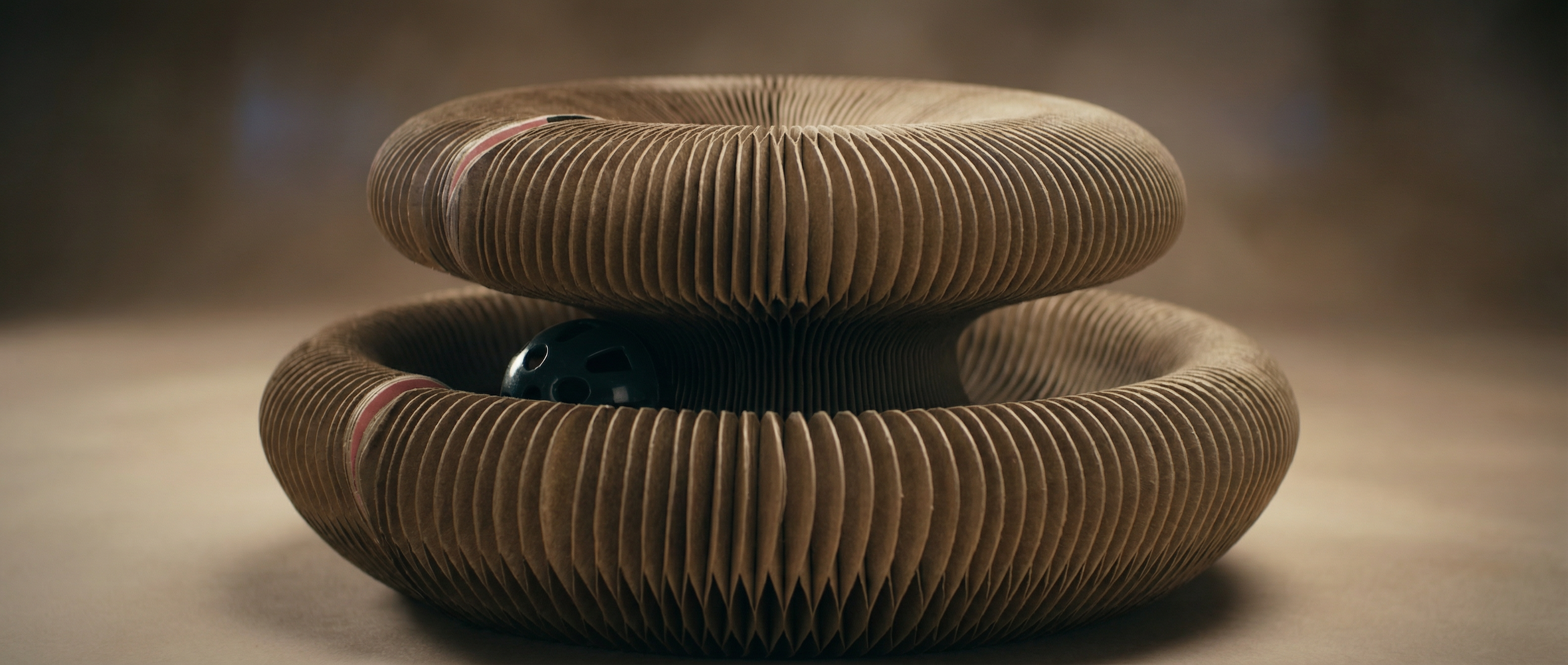
Built for how cats actually think. Not how toys look on product pages.
The accordion structure, the ball-chase track, the organic cardboard, the magnetic connector system — each one exists to solve a specific biological problem. Not a marketing problem. A biology problem.
Accordion shape that reconfigures
Expands, contracts, rebuilds into completely different layouts. The environment your cat explores today looks different from last week. Novelty never expires. The brain never reclassifies it as background. The scratcher never becomes invisible — because it never stays the same.
Integrated ball-chase hunt track
The full predatory sequence — stalk, chase, catch, scratch, sleep — completes itself without a human standing over it. Attack energy has a real target. Works all day, alone. That's the guilt off your chest, the scars off your hands, and the weight starting to come off without a single forced laser session.
High-density organic cardboard
The texture cats are biologically wired to seek — how tree bark feels to a wild cat. Dense enough not to shed dust everywhere. Satisfying enough that cats genuinely choose it over furniture they've been shredding for years. Not because you put it there. Because it's actually better.
Magnetic connector system
Each unit connects to expand the structure over time. Change the layout when novelty starts to fade. A 3-year-old cat and a 14-year-old cat both get something new to discover — and the brain stays engaged the way the research says matters most for everything downstream.

We solved one thing.
It fixed five.
A bored cat either destroys your stuff or destroys your peace — usually both. When the hunt drive gets what it actually needs, everything downstream changes. All five problems. Same root. Same answer.
We're not going to tell you
this is the last toy you'll buy.
You've read that line on every product that got ignored within a week. You've checked the reviews, watched the videos, bought the thing, and watched your cat walk right past it on day four. That skepticism is completely fair — and it's been completely earned by an industry that keeps selling features instead of solving problems.
So here's what we'll tell you instead. For the person whose couch is held together with prayers and double-sided tape: this was built so cats genuinely choose it. Not because they have to. Because their brain keeps finding it new.
For the person who spends the whole commute wondering if they're okay in there: it works all day without you. No standing over it. No twenty-minute wand sessions. It hunts on their behalf when you can't be there.
For the person who flinches walking past their own hallway at night: there's a specific answer that doesn't require thick socks or closed doors. A cat with a real hunt target doesn't need to find one on your arms.
For the person with the number from the vet still sitting in their chest: this is exercise that doesn't feel like exercise. The hunt drive makes them move because biology demands it — not because you're forcing it at 9pm with a laser pointer.
For the person calculating how many good years are left and quietly terrified of the answer: every session is enrichment. Every session is you, giving them the one thing the research consistently points to — a brain that has somewhere real to go. Starting now, while the window is still open.
Give them everything
they were built to do.
Every cat is a small wild animal living inside your home, trying to make the best of a world that removed everything they were born for. The scratching wasn't spite. The attacks weren't hatred. The loneliness wasn't inevitable. The weight wasn't laziness. The fading mind wasn't certain.
It all started in the same place. And it can all change.
— The KittyLoop™ Team
Shop KittyLoop™ 🐾